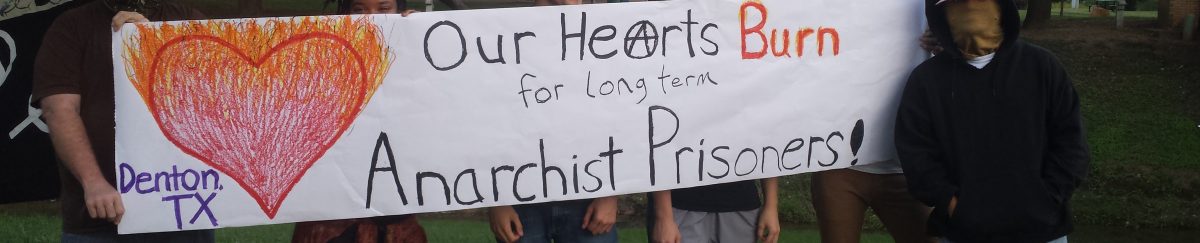
This year as we are marking the International Day of Solidarity with Marius Mason and All Long-Term Anarchist Prisoners we are thinking about the nature of solidarity as ever-changing and never-ending. Our solidarity is not just for those who are imprisoned, but for all those who are harassed, intimidated, deported, hunted, on the run, tortured, and even killed — not just for individuals but for the struggles they are a part of. Just as repression ebbs and flows and state tactics adapt, transform, and innovate, so must our practice of active solidarity. We must adapt to the changing terrain and needs of our movements.
Solidarity does not end when trial ends and a verdict is reached, when a hunger strike has gotten its demands met, or even when somebody is released from custody back into the arms of their family and friends. The consequences of state repression last long beyond big moments and media attention. Whenever one cycle of struggle winds down as the target of the state, another will take its place. Whenever one comrade is released from prison, another will be taken in. Our support must continue to ripple out beyond our friends and immediate networks. It must extend beyond the borders of states into all lands and territories where people are fighting. It must expand beyond the present moment, honoring comrades of the past and thinking of what legacy we will leave for those who come after us.
While our tactics and strategies change and evolve over time, we must always meet the moment with an impulse to push ahead and not remain waiting. We may take moments of evasion and defensive posture, only to come back stronger and more intransigent. The context we find ourselves is always changing, but our purpose remains the same. Solidarity without end means always acting towards the goal of destroying the prevailing order.
The stakes remain the same even as the terrain shifts. The threats remain the same even if they are becoming more common. Previously short sentences have become longer with terrorist designations and enhancements. Camps develop beside prisons. Policing becomes a more obvious occupation. Murders become genocides. This isn’t new, but really a return to a previously escalated state that built the settler-colonial empires. The far right reactionaries of the world have been regaining influence and power for quite some time, building off of the fear of concurrent crises, while the moderates try to cling to a modern status quo by treading water in a rising, turbulent tide. The crises are real — so are the economic downturns and increasing shortages, and so will be the violence handed down from on high as authorities try to maintain and further centralize their power.
Anarchists and others who speak and act out are already being explicitly targeted in Iran, Russia, Belarus, Indonesia, Italy, Greece, Mexico, the US, and elsewhere. Those who seek to maintain the status quo cry out, “they can’t do that!” We acknowledge they always have, if only on smaller and more polite scales in the recent past. The fear of those in power is also being realized, as we see the proliferations of uprisings around the world crashing like waves upon an eroding beach. We see how authority is vulnerable in crisis as the fight returns to old venues like workplaces and barricades, while we also plot out new avenues of attack.
The consequences for acting against the dominant order seem to be escalating, so we are pushed to acknowledge what we’ve always known to be true: half measures are a trap. Collaborating with the left and moderate statists on their terms is just empowering them to their own coercion and top-down violence should they win out. We find productive accomplices when we act on anarchist principles, building empowerment of everyone against any new authority. The power over our lives must remain in our own hands — unmediated — and it seems a great deal of people acknowledge this when data centers and artificial intelligence become a focus of resistance.
The ongoing climate catastrophe was acknowledged by our imprisoned fighters decades ago while new technologies like AI continue the ecocidal course. Preparing for the shortages, we shell up to counterattack — ideally without fortifying to the point of not being adaptable. As the terrain shifts we can remain mobile, without waiting for the new repression. Solidarity without end is anticipatory as much as it is active.
Confronting the real stakes of our struggles – life and death – need not lead us down the path of constant pessimism. Instead, it can provide us with the gift of appreciation for each small victory and mundane, beautiful thing. This too, is a cycle of solidarity. There are days that break our hearts. There are days that once again fill them up again so much we fear they might burst out of our chests. Each comrade is precious. As is every release, acquittal, dropped charge, or non-cooperating plea to get time-served, each small victory won through a strike, each collective action or bold individual revolt despite everything telling them its not worth it. We must allow every one to bring a smile to our faces, even while so many others remain caged. We must allow each small victory to take its place in the narrative of our struggles, connecting past to future. We must let this appreciation give us strength and daring. This year, we are celebrating the recent release of Hybachi LeMar, Peppy, and Casey Brezik. Marius Mason, after nearly two decades in federal prison, is set to be released to a halfway house in May of this year. Charges are starting to get dismissed for the Stop Cop City defendants in the U.S. Monica Caballero in Chile is up for another chance at parole. Charges have been dismissed against a comrade in Munich and 5 anarchists in Belarus have been released. Active, principles, and expansive solidarity continues across the world, especially exemplified by comrades in Greece around the Ampelokipi trial.
PRISONER UPDATES
After 17 years, Marius Mason is set to be released from federal custody this year, though the timeline is uncertain. He will be going to a half-way house in Michigan. From his statement accompanying this announcement: “What I really want you all to know is how incredibly proud it made me to be part of a community of resistance that stood together. It impressed the people I met in prison for so much love and solidarity to be expressed so powerfully for someone who was behind the walls. It demonstrated that in our movement, though we were physically separated, we could stay together in spirit, that solidarity and love are action words, and that we are all in it for the long haul.”
Michael Kimble, still going through a legal process do get re-sentenced and hopefully released, was recently transferred to a lower security work release facility. He can now at least get some fresh air. Fundraising is ongoing for his legal fees and to support him financially in the meantime. Sean Swain is up for parole again. Xinachtli has been transferred to a new unit where his conditions of extreme medical neglect of only worsened. Despite being unable to walk, he has been denied mobility aids. Nevertheless, he continues to write, create, and resist.
Casey Goonan, a dedicated community educator, writer, distroist, and printer who has lived a life committed to struggles for liberation was arrested in June of 2024 for actions, including the arson of a UC Berkeley Police vehicle, in response to the University’s treatment of student protesters for Palestine. In September of 2025, Casey was sentenced to 19 years in prison. Casey had been in holdover at FCI Mendota, awaiting their permanent placement. Life at FCI Mendota was uncertain and challenging, as they were denied access to sufficient medical care to manage their diabetes, and had lived without personal property, stimulating programs or much time outside their cell. In February 2026, Casey was finally to FCI Allenwood in Northern Pennsylvania. This placement might be temporary, but for the time being they have better medical care, phone access, time out of their cell and time in the library. They are working on a habeas petition with another legal team in order to appeal their conviction and sentencing.
The Prairieland Case revolves around a noise demo on July 4, 2025 at the Prairieland ICE Detention Facility in Alvarado, Texas. It is the Trump administration’s first attempt at an ‘Antifa’ terrorist organization case. The defendants are facing incredibly lengthy sentences as the prosecution has emphasized a conspiracy among a wide network of defendants, alleging a planned ambush on officers, and is using this case as an opportunity to set a precedent of extreme consequences for protesting ICE and the Trump administration. Nine of the defendants have undergone federal trial, eight of whom have committed to non-cooperation: Autumn Hill, Zachary Evetts, Champagne Song, Savanna Batten, Maricela Rueda, Elizabeth Soto, and Ines Soto, and Daniel “Des” Rolando Sanchez Estrada. Defendants have weathered confusing antics and an initial mistrial from the Trump-appointed judge. Sentencing will happen in the early summer, though legal teams are looking at the possibilities of appealing the verdict. Additionally Joy “Rowan” Gibson and Rebecca Morgan have both signed non-cooperating pleas and are awaiting sentencing. Other defendants have upcoming state-level trials. Six of the defendants have chosen to cooperate with the State. Attention, support and solidarity for the defendants who have committed to non-cooperation will be a long-term endeavor.
Malik Muhammad spent much of this past year in solitary confinement at two different facilities in Oregon. Malik has stayed active sharing writing, learning to draw, and embarking on hunger strikes and phone zaps to protest their mistreatment and that of other prisoners. On the heels of a phone zap campaign to get Malik out of solitary, they disappeared from prison databases for a week during an interstate transfer. Malik is now in prison in South Carolina, a move that is retaliatory in nature due to Malik’s identity and recalcitrant political activity.
A new case came about against several anarchists after an accidental explosion in an apartment in Greece on Halloween of 2024. Several who weren’t present were acquitted, including Nikos Romanos who was charged after a single fingerprint of his was found on the outside of a trash bag. Unfortunately, Dimitra received an 8 year sentence for merely lending a key to the apartment for visitors to stay in, and Marianna received 19 years just for being present in the apartment while her partner, Kyriakos, worked on the device. Marianna was severely injured in the explosion, and the counter-terrorism unit (always aggressive towards anarchists) crossed many lines with her as the took samples of her DNA while she was unconscious in her hospital bed, for instance. A week of solidarity began in the week leading up to the April start date of the trial, and scuffles occurred outside the courtroom between supporters and police quite early on. Throughout the course of these events we are shown how anarchists can be “proudly faithful to the concept of active solidarity” and continue to advocate for freedom, even under duress.
This spring in Chile, Mónica Caballero will be under review for conditional release once again. The commission of judges from the court of appeals has previously denied her release, despite meeting all legal requirements, due to her anti-authoritarian politics. This comes as no surprise to those that remain enemious to the authorities and their order. Her accomplice, Francisco Solar, returned to general population last year after five years in solitary. He remains defiant, as evidenced by his words for Sara and Alessandro, who died in Italy this past March while making an explosive device.
Italian anarchists have been undergoing waves of repression. After a demonstration in March of 2023 in solidarity with Alfredo Cospito during his incredible 6 month hunger strike, the Italian state has turned its ire toward many of the demonstrators present that day. “Operation City” is the pursuit of those comrades in Turin who sought to undermine Italy’s attempt to kill Alfredo, and to protect themselves in the course of the protest. More than 60 people were charged, interrupting their lives. Those 18 comrades facing conspiracy to commit aggravated damage and conspiracy to commit assault against a public official have now been convicted with sentences ranging from one-and-a-half to five-and-a-half years. The comrades accused of complicity in acts of vandalism, aggravated resistance, and possession of offensive objects now face a trial which is expected to begin in November of this year. Alfredo remains imprisoned under the draconian 41 bis regime, where his supporters expect his torturous conditions to continue.
In Belarus, anarchists Andrei Chapiuk, Akikhira Hajeuski-Khanada, Mikalai Dziadok, Pavel Shpetny and Aleksandr Kozlyanko have been released! This typically means being expelled from the Belarusian territories and needing support in starting over. In 2025, nine anarchists had their prison terms extended — from 6 months to 2 years — for “persistent disobedience to prison administration.” Early this year, Nikita Dranets, Aleksey Golovko, and Aleksandr Frantskevich also remain in prison after receiving up to an additional year on their sentences. At the end of February, the KGB updated the “List of persons involved in terrorist activities” to include anarchists from the Black Nightingales group: Siarhei Zhyhaliou, Trafim Barysau, Dzmitry Zakharoshka, Aliaksandra Pulinovich, and Maryia Misiuk. This means that in addition to the 10-13 year sentences they received for “plotting anti-war sabotage,” they also can’t receive any money transfers — meaning they can only purchase goods using funds that were already in their accounts beforehand, or money they “earn” through labor in the colony they were transferred to. Maryia Misiuk, a Ukrainian citizen, was released and deported last November, but was then exchanged in a Russia–Ukraine prisoner swap immediately after and sent back to prison in Belarus — she and her codefendants were also only teenagers at the time of their arrest. ABC Belarus continues doing support work for these and others, including holding an event in Germany about the 2020 protests and the repression of the Anarcho-Partisans who continue their two decade sentences.
In Germany, repression presents itself as authorities are frustrated over their inability to catch or prosecute infrastructure saboteurs. A raid in March on Infoladen and Scherer 8 house project in Berlin tried to connect anarchists to these acts. Many prisoner support events have occurred there in the past, and will continue. In Munich, the Zündlumpen case continues its rollercoaster trajectory. Unable to link a third person to the anarchist paper, the state had to dismiss the case of criminal association, but the other charges persists. The two anarchist comrades, Manuel and Nathalie, who remain persecuted, face charges of arson and theft, respectively. The latest hilarious write up calls into question the dubious claims around the state’s body odor evidence and their claims to unwarranted wiretaps, but concludes: “We in any case will leave the jurists to their legalism and would rather stick to our anarchism.”
In 2025 ABC Moscow carried out several successful evacuations of anarchists facing criminal charges in Russia. They also continue to fundraise for Ruslan Sidiki’s legal fees as he awaits a ruling on his appeal against a 29 year sentence for anti-military actions. Ruslan has been denied access to reading material and the state refuses to investigate the torture he endured during his arrest. He received a record-setting sentence for a non-lethal drone bombing of a military airfield and derailing a freight train in 2023. The Russian state has also retained custody of Nikita Uvarov by opening a new case against him during his final month in a penal colony. He had nearly completed his five year sentence for hanging up posters in support of prisoners, talking about blowing up the FSB building in minecraft (literally), and playing with firecrackers with his friends. He was originally convicted when he was just 14 years old. Moscow ABC was also criminalized so a new organization called Fires of Freedom has been created to operate legally in the country. They recently began a fundraiser for anarchist and former 20-year political prisoner Ilya Romanov, who requires the help of a full time caregiver.
After incredible anti-government riots in Indonesia in 2025, dozens of cases have been opened against anarchists. According to a few of the anarchist prisoners, “703 political prisoners — although we reject that label — are still undergoing legal processes or are detained” as of March 2026. The approximately 70 anarchists facing charges includes Albi, Pem, Herdi, Adit, Naufal, and Dena, who all have trials beginning in April of this year. Rizky Ardiansyah (known as Riky) and Muhammad Rafli Andriansyah (referred to as Kipli), among the first to be arrested after the uprising, face severe charges that are said to be more political than factual. In at least one instance, Alfarisi bin Rikosen (one of 32 anarchists detained in Surabaya) died as a result of the police torture he endured. Such abuse seems widespread among all detainees. Many of the anarchists face 5 year sentences for riot, arson, and property destruction – but a handful face more than 20 years each stemming from accusations of more violent actions and supposed leadership. One of these comrades, Adit, is a part of the state-fabricated, 40 person “Chaos Star Network” – and the state has successfully accumulated a great deal of trial-ready evidence against him. He was already under surveillance, possibly stemming from the case against him from 2024, in which he, Opal, Pem, Herdi, and one person who turned informant, are accused of blowing up a police outpost in solidarity with Alfredo Cospito, Nikos Romanos, and all anarchist prisoners.
After five years of imprisonment in Mexico, and several more years of legal fights (and four ongoing years of exile), Mazatec anarchist Miguel Peralta beat the attempted murder charges stemming from his participation in the defense of the Xangá Ndá Ge River more than ten years ago. This February 2026 resolution could help alleviate the judicial burden on much of Eloxochitlán de Flores Magón where more than 50 arrest warrants were issued around indigenous resistance to resource extraction companies and other incursions of capital and the state. At the time of this writing we are awaiting a full acquittal for Miguel. Anarchist Arturo Lugo was arrested in Guadalajara on January 8, of this year, likely in retribuion for his participation in the protests at FES Acatlán school (UNAM), where he was stood up against institutionalized sexual harassment in 2020. In Mexico last year, Jorge “Yorch” Esquivel was not provided prompt or adequate medical aid for his chronic gastrointestinal issues by prison authorities. He died in hospital on December 9th, 2025.
The genocide continues against Palestinians; atrocities continue against the people of Sudan; wars continue in Ukraine, Iran and Myanmar; and clashes continue in Syria and Rojava. The millions fleeing violence and persecution create populations of refugees in camps as well as diasporas and intermingling of revolutionaries across borders. There is an increase in not only arrests and imprisonment but state executions. Iran has already sentenced to death dozens of protesters from the uprising earlier this year. Among the hundreds of Iranian detainees are anarchists Soheil Arabi and Afshin Heyratian. Israel is posed to execute possibly thousands more Palestinians under a new law. Anarchists, because of our orientation of constant hostility towards the state and other oppressors, always face a baseline of oppression. We must assess how this repression evolves not only in right-ward turns and collapsing empires, but also in times of all-out war, within and even beyond the borders of all the involved states. “Rights” and what we come to expect from police behavior and court proceedings can be trusted less and less. States of exception become the norm. Anarchists and anti-authoritarian internationalists must figure out how to adapt to these changing conditions, resist the narratives of state-vs-state conflicts, and be pro-active in defending each other and offering radically different ways of living.
The state pursuing cases of conspiracy around movements, ideas, values and associations is likely to only grow. If they can’t catch individual actors, they will move to make us all suffer. While this context might be unique in some ways, the methods are a regurgitation of what has come before, a repetition of what has always been. This approach is meant to instill a paranoia and fear in us; it is meant to create a fear that breaks us. To make us fear our relationships and see those around us as only a potential ‘risk’ to our sense of safety or comfort. It is in committing to turn away from this fear and instead choosing to bolster ourselves, our relationships, our networks of counter-repression and our capacity towards action in all its forms, that we can grow to be truly strong, bold, and moving towards freedom, regardless of the changes in the terrain of laws, alliances, prisons and the ruling order.
Things in the world are shifting and unraveling. Each moment of revolt, when anything feels possible, is inevitably followed by lulls, burnouts, repression, and the threat of a suffocating routine. Experimentation and taking different types of risks is necessary, as is the constant balance of living in the present while considering the terrain of our lives and movements, long-term. Where in your own life might you try something new? Learn to take a chance on something intangible, or move on something with a measurable effect? How can those in jail or prison be better included in what is happening in your life? What are some ways to widen the crack in the facade of impenetrability that those in power intend to impose? How might you handle repression in your life and help those around you cultivate ideas and practices that empower us to stand up against the state? How might these practices be innovated, multiply and trickle beyond our worlds?
Our practice of solidarity is not just one of obligation, but of recognition that an ever-expanding and never-ending solidarity as part of the path to all of our freedom. Because we know ourselves to be more connected, stronger, and ultimately more capable when it is always a part of what guides us. We know there is no fixed limit or end, and the need for solidarity will always be there. We know that we find richness in the ways that it deepens our movements and selves.